Strategic ministerial meeting unites democracies against the resurgence of terrorism
Carlos Sánchez Berzaín
July 20, 2026
(Interamerican Institute for Democracy) At the initiative of the U.S. Secretary of State, the “Ministerial Meeting on the Resurgence of Political Terrorism” was held on July 16 in Washington, D.C., with the participation of more than 60 countries. Its strategic importance lies in the recognition of the transnational threat and the beginning of the reconstruction of the counterterrorism architecture of democracies to confront the threat together.
Terrorism is “domination through terror”; terror is “intense fear, the exacerbation of fear”; “a succession of violent acts carried out to instill terror.” Political terrorism is “a type of premeditated violence perpetrated by organized groups that repeatedly aims to create social alarm for political purposes.”
Terrorism is “a crime against public safety consisting of the commission of acts of violence qualified by the means employed, with the purpose of disturbing order, terrorizing society or certain groups or carrying out revenge or reprisals, in order to disintegrate the political and social regime.”
Violence used to instill terror and the attempt to dismantle the political and social system are crimes against freedom and democracy within the framework of the international system founded on respect for human rights and the Inter-American system, which recognizes democracy as “the right of peoples that governments have the obligation to promote and defend.” Terrorists are criminals and, in many cases, perpetrators of crimes against humanity.
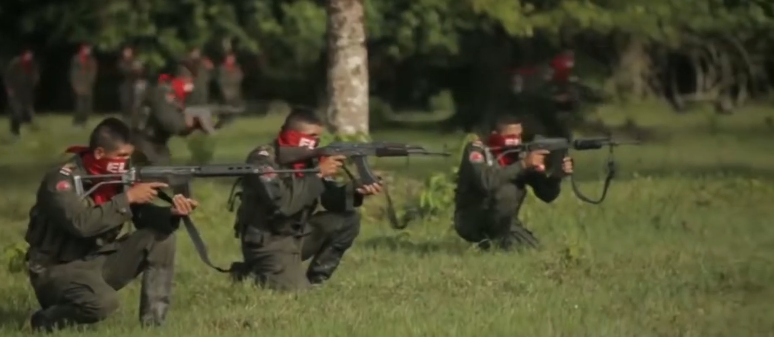
Secretary Marco Rubio stated: “Each of our friends here from the nations of the Western Hemisphere remembers the decades of kidnappings, bombings, assassinations, and executions; the violent terror of the Tupamaros, the Montoneros, the FARC, the ELN…the inhuman savagery of Peru’s Shining Path, the Maoist fanatics who massacred peasant villages in Peru, hacking pregnant women and newborn babies to death with machetes. Do you remember the tens of thousands of Marxist guerrillas trained to kill in Castro’s terrorist camps?… That is radical leftism. It may adopt various slogans and ideologies depending on the place and time; they may call themselves anti-capitalist, anti-imperialist, communist, anarchist, or Marxist. But its fundamental nature is always the same.”
Acknowledging the transnational nature of crime, he cited cases of terrorism worldwide and added: “We face an international threat… a transnational threat. These are not isolated, independent cells, but interconnected networks. They do not recognize our borders; in fact, they do not even believe in the concept of the nation-state. They coordinate, communicate, travel, train, and act together, sharing the same infrastructure, the same enemies, and the same mission.”
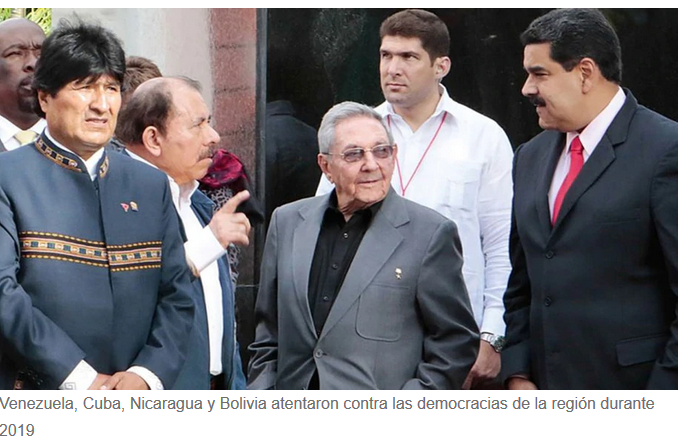
Through Rubio, the United States has directly pointed the finger at the dictatorships of Iran and Cuba, stating that terrorists “collaborate with hostile foreign states that share their mission, such as Iranian proxies—increasingly linked to militant left-wing groups around the world. The Cuban regime’s extensive intelligence and ideological network helped forge the extreme left in our country (the US) and in our hemisphere (the Americas), and remains inextricably linked to far-left groups and movements in the West and beyond.”
The strategy proposed by the United States through Secretary Rubio was supported by Stephen Miller, White House Deputy Chief of Staff for Policy and National Security Advisor, Treasury Secretary Scott Besset, FBI Director Kash Patel, and Secretary of Education Linda McMahon. Miller stated that: “one of the defining characteristics of left-wing violence and terrorism is its entirely contrived and dishonest invocation of civil liberties in order to shield its own violence.”
This is the tactic the left always uses to try to protect itself from criminal penalties. It is essential that we have the wisdom and resolve to understand that such claims must fall on deaf ears.
Highlighting the urgent need for democracies to unite and rebuild the counterterrorism architecture, Rubio detailed the alarming reality that «Today’s far-left terrorists can raise funds in one country, host their communications in a second, receive training in a third, recruit militants in a fourth, and finally, attack a target together in a fifth country.»
With this meeting, the United States and more than 60 democracies from the region and the world have designated the dictatorships of Iran and Cuba as terrorist organizations. Cuba, with its 21st-century socialism or Castro-Chavismo structure, is the political figurehead of the left. The absence of the para-dictatorial governments of Brazil (founder and operator of the São Paulo Forum under Lula) and Mexico is noteworthy, as both are defenders of the Cuban dictatorship and part of the 21st-century socialist movement.
We are living through a global geopolitical shift that recognizes objective reality, calls crimes by their name, and proposes and leads concrete strategies for the defense of freedom and democracy for all peoples.
*Lawyer and Political Scientist. Director of the Interamerican Institute for Democracy.
Published in Spanish by infobae.com Monday July 20th, 2026